I am currently a Camera Design Lead at Apple, where I work on camera hardware design, integration, and validation for high-performance imaging systems.
Previously, I completed my PhD in Electrical and Computer Engineering at UW–Madison in the Computational Optics Lab, where I was fortunate to be advised by Andreas Velten. My doctoral research focused on computational imaging systems that combine optical hardware, emerging sensor technologies, and advanced reconstruction algorithms for applications including 3D imaging, non-line-of-sight imaging, and transient imaging.
Education
-
 University of Wisconsin - MadisonPh.D. in Electrical and Computer Engineering2025
 -
University of Wisconsin - MadisonMasters in Electrical and Computer Engineering2020
-
 University of Wisconsin - MadisonB.S. in Chemical Engineering and Math
Certificate in Computer Science2018
News
Selected Publications (view all )
Iterating the Transient Light Transport Matrix for Non-Line-of-Sight Imaging
Talha Sultan, Eric Brandt, Khadijeh Masumnia-Bisheh, Simone Riccardo, Pavel Polynkin, Alberto Tosi, Andreas Velten
Nature Communications, 17, 8951. 2026
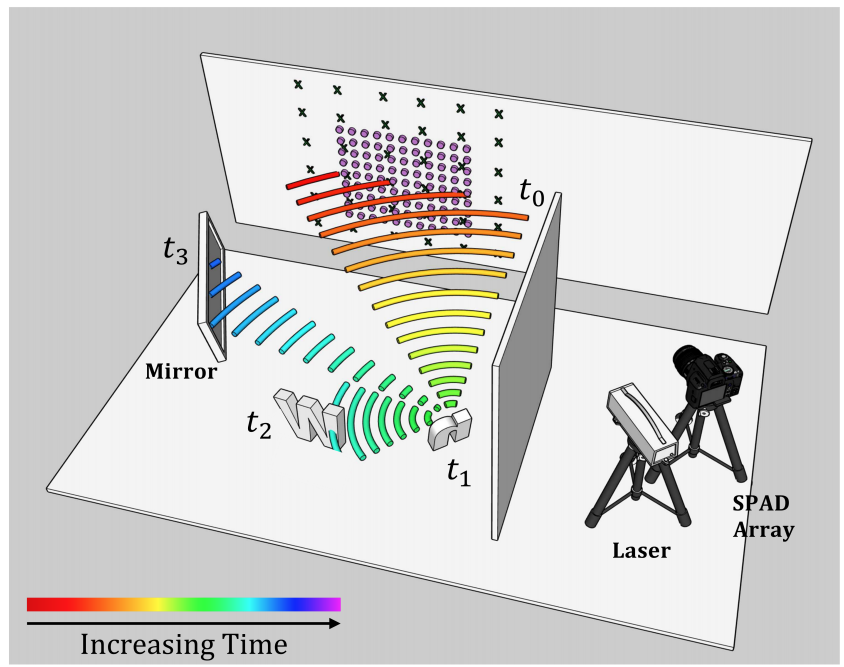
We capture transient light transport with a dense laser scan and a gated SPAD array, then independently focus virtual illumination and detection within a hidden scene. The reconstructed transport matrix reveals time-resolved interactions between hidden surfaces, including indirect shadows, interreflections, and volumetric scattering, and enables direct–indirect separation, relighting, and dual photography.
Iterating the Transient Light Transport Matrix for Non-Line-of-Sight Imaging
Talha Sultan, Eric Brandt, Khadijeh Masumnia-Bisheh, Simone Riccardo, Pavel Polynkin, Alberto Tosi, Andreas Velten
Nature Communications, 17, 8951. 2026
We capture transient light transport with a dense laser scan and a gated SPAD array, then independently focus virtual illumination and detection within a hidden scene. The reconstructed transport matrix reveals time-resolved interactions between hidden surfaces, including indirect shadows, interreflections, and volumetric scattering, and enables direct–indirect separation, relighting, and dual photography.
Optimized Sampling for Non-Line-of-Sight Imaging Using Modified Fast Fourier Transforms
Talha Sultan, Alex Bocchieri, Chaoying Gu, Xiaochun Liu, Pavel Polynkin, Andreas Velten
Under review.
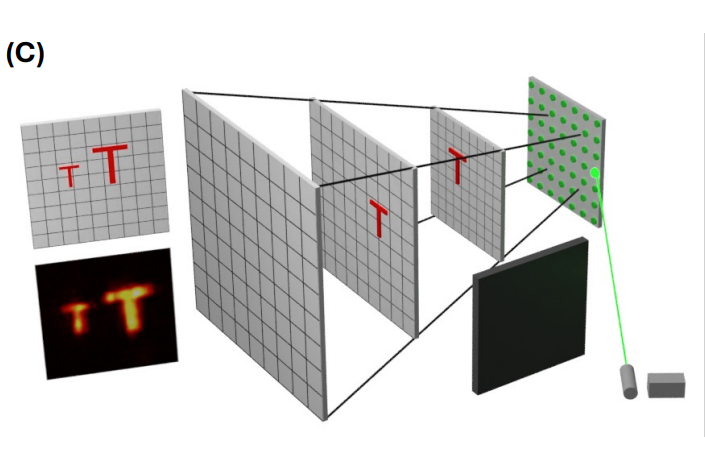
We demonstrate that the measurement space for non-line-of-sight imaging can be compressed, enabling the development of novel computational methods for 3D diffraction propagation. These methods allow for flexible measurement schemes and significantly enhance reconstruction speed while maintaining reconstruction quality comparable to state-of-the-art methods.
Optimized Sampling for Non-Line-of-Sight Imaging Using Modified Fast Fourier Transforms
Talha Sultan, Alex Bocchieri, Chaoying Gu, Xiaochun Liu, Pavel Polynkin, Andreas Velten
Under review.
We demonstrate that the measurement space for non-line-of-sight imaging can be compressed, enabling the development of novel computational methods for 3D diffraction propagation. These methods allow for flexible measurement schemes and significantly enhance reconstruction speed while maintaining reconstruction quality comparable to state-of-the-art methods.
Virtual Mirrors: Non-Line-of-Sight Imaging Beyond the Third Bounce
Diego Royo, Talha Sultan, Adolfo Muñoz, Khadijeh Masumnia-Bisheh, Eric Brandt, Diego Gutierrez, Andreas Velten, Julio Marco
SIGGRAPH 2023
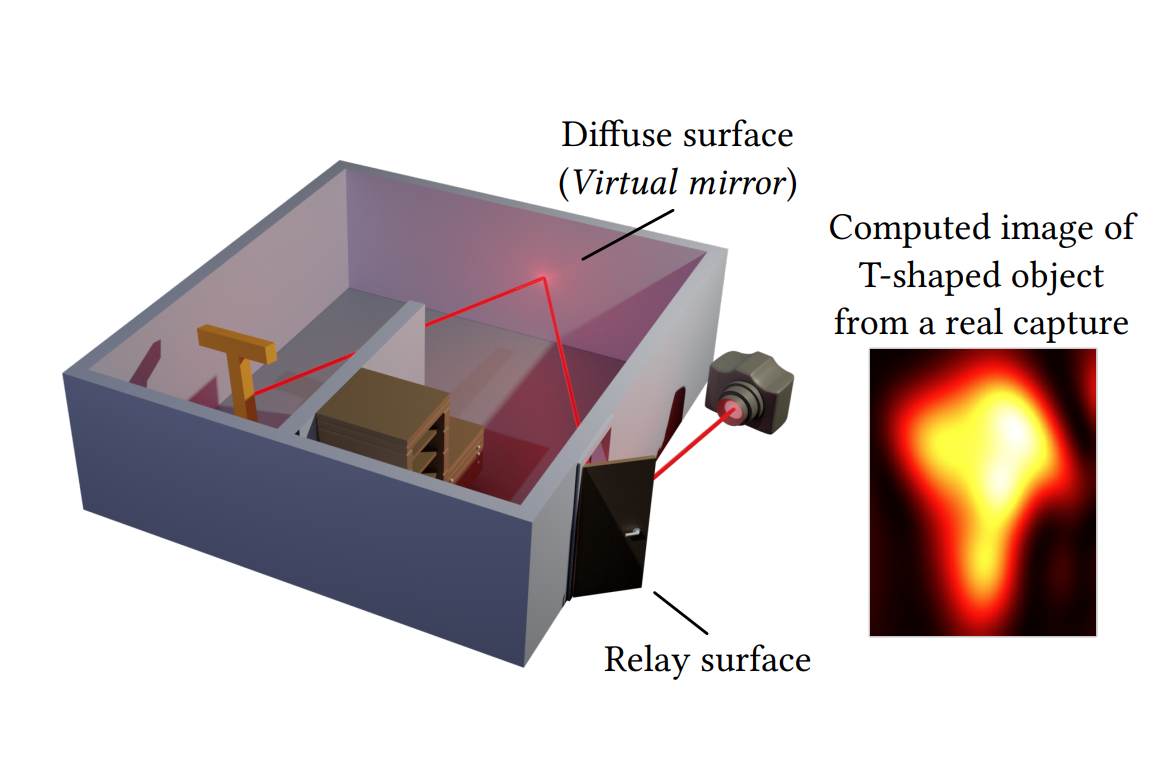
We show that planar diffuse surfaces can act as virtual mirrors in non-line-of-sight (NLOS) imaging when using structured light modulation at centimeter-scale wavelengths. Leveraging this effect, we extend NLOS imaging beyond the third bounce, enabling the reconstruction of mirror reflections of objects hidden around two corners.
Virtual Mirrors: Non-Line-of-Sight Imaging Beyond the Third Bounce
Diego Royo, Talha Sultan, Adolfo Muñoz, Khadijeh Masumnia-Bisheh, Eric Brandt, Diego Gutierrez, Andreas Velten, Julio Marco
SIGGRAPH 2023
We show that planar diffuse surfaces can act as virtual mirrors in non-line-of-sight (NLOS) imaging when using structured light modulation at centimeter-scale wavelengths. Leveraging this effect, we extend NLOS imaging beyond the third bounce, enabling the reconstruction of mirror reflections of objects hidden around two corners.